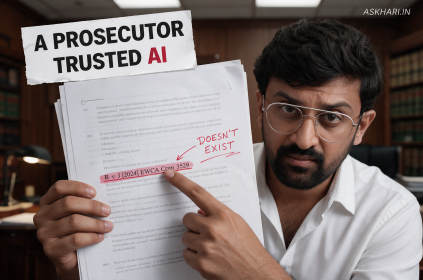
An AI hallucination in court has reached one of England’s most senior prosecuting offices. The Guardian reported on 3 November 2026 that a senior Crown Prosecution Service (CPS) lawyer cited a legal precedent to the High Court that doesn’t exist. The fake case came from an AI summary in an ordinary internet search. Here’s what happened and how anyone can avoid the same trap.
Key takeaways
- What: a CPS prosecutor cited “R v J [2024] EWCA Crim 3529”, a case that doesn’t exist, in a High Court dispute.
- Source of the error: an AI summary returned during an internet search, according to The Guardian.
- Outcome: the court said the error didn’t change its decision, but two senior judges called the explanation “unsatisfactory”.
- Scale: it’s the 101st entry in a UK tracker of AI-related court errors.
- Lesson: always check citations in an official legal database.
Last updated: 4 November 2026 · Status: reported, CPS review done.
[Insert “Table of Contents by Rank Math” block here]
What happened in this AI hallucination in court?
According to The Guardian, a senior crown prosecutor in the CPS’s rape and serious sexual offences unit submitted a detailed reference to a case that turned out not to exist, in a serious youth prosecution. In October she admitted the error and said she had meant a real decision from 15 years earlier. The Guardian understands the citation came from an AI response during an internet search.
What did the court and the CPS say?
The High Court said the fictitious case didn’t affect the outcome of the challenge. Two senior judges called the explanation “unsatisfactory”. The CPS said it has a strict AI policy so AI “is not used to make legal decisions and there must be human checks for accuracy”, and that a review found no other cases affected. Its lesson: “case law must be cited from trusted legal sources.”
Brian Flanagan, a law professor at Maynooth University, called it “a serious failure” because the false authority was used by the state to argue for prosecuting a child.
How common are fake case citations?
| Fact | Figure |
|---|---|
| Entries in Matthew Lee’s UK AI-error tracker | 101 |
| Known CPS cases | 2 (February and now) |
| High Court warning to lawyers | June 2025 |
Barrister Matthew Lee of Doughty Street Chambers, who keeps the tracker, said the known cases may be the “tip of the iceberg” because many lower court decisions are never published. Most involve people representing themselves, but professionals are now appearing too.
Why do AI hallucinations invent legal cases?
Language models predict plausible text. A case name with a real-looking citation format is plausible text, even if no such case exists. Search summaries such as AI Overviews can repeat that kind of error confidently. The risk is highest when the user is in a hurry and the answer looks exactly like what they expected.
How to avoid an AI hallucination in court or at work
- Never cite a case, law or statistic you haven’t opened at the original source.
- For Indian law, check judgments on official sources such as the Supreme Court or High Court websites, or a trusted legal database.
- Search the exact citation. If it returns nothing but AI summaries, treat it as fake.
- Keep a note of where each citation came from.
What it means for India
The same risk applies in India. Law students, junior lawyers and anyone drafting legal notices with AI help should apply the same rule as the CPS now does: AI can help you find leads, but only an official source can confirm them.
Watch: AI hallucination in court, explained
[Paste your YouTube or Instagram video link on an empty line below.]
What is an AI hallucination, in plain English?
An AI hallucination is when an AI tool states something false with full confidence. It isn’t lying in the human sense. Large language models generate the most likely next words based on patterns, and a realistic-looking legal citation is a very likely pattern even when no such case exists.
Legal citations are especially easy to fake because they follow strict formats: party names, a year in brackets, a court code and a number. An AI that has seen thousands of real citations can produce a new one that looks perfect. That is exactly what happened with “R v J [2024] EWCA Crim 3529”.
| Part of the fake citation | What it pretends to be |
|---|---|
| R v J | A criminal case: the Crown against a defendant called J |
| [2024] | The year of the judgment |
| EWCA Crim | Court of Appeal of England and Wales, Criminal Division |
| 3529 | The case number |
Earlier cases of AI hallucinations in court
This is far from the first fake case citation. The pattern began in 2023 and has grown each year as AI tools spread.
| When | Where | What happened |
|---|---|---|
| 2023 | New York, US (Mata v. Avianca) | Lawyers fined $5,000 after filing a brief with made-up cases from ChatGPT |
| June 2025 | High Court, England and Wales | Judges warned lawyers that misusing AI could lead to sanctions or police referral |
| February 2026 | CPS extradition case, UK | Non-existent authorities cited, likely caused by AI, The Guardian reports |
| October 2026 | D.C. Court of Appeals, US | A bank’s brief was struck after four AI-generated cases were found, according to reports |
| November 2026 | High Court, England and Wales | CPS prosecutor cites a fake case from an AI search summary |
The difference now is the source. Early cases came from people asking chatbots directly. The latest came from an AI summary inside an ordinary internet search, which many users don’t even think of as AI.
Why are AI search summaries risky for research?
AI Overviews and similar search summaries appear at the top of the page, look authoritative and save time. That combination makes people less likely to click through and check. In a busy legal office, a confident summary with a case name can feel like enough.
- No clear source: a summary may not link the exact document behind each claim.
- Mixed information: it can blend real and invented details in one answer.
- Time pressure: the faster the work, the more tempting it is to trust the first answer.
- Old research may not apply: studies of hallucination rates on older models can go out of date quickly, as Stanford found in its review of AI research findings.
What do the rules say about AI in court?
In England and Wales, the High Court said in June 2025 that lawyers who misuse AI could face sanctions ranging from public admonishment to contempt of court proceedings and police referral, according to The Guardian. It asked the Bar Council and the Law Society to act “as a matter of urgency”. Judges in the UK also have official guidance on using AI carefully.
The CPS says its own policy limits AI so that it “is not used to make legal decisions and there must be human checks for accuracy”. The latest case shows that a policy only works if research tools that quietly include AI are covered too.
How to check a legal citation in India
The safest rule is simple: never cite a judgment you haven’t opened and read at a trusted source. In India, these sources help:
- Supreme Court of India website: search judgments by case number, party name or date.
- High Court websites: each High Court publishes its own judgments and orders.
- eCourts services: the government’s eCourts portal tracks cases and orders across district courts.
- Established legal databases: use well-known databases, and still confirm important judgments against the official court copy.
- Read the actual paragraph: make sure the judgment says what you claim, not just that it exists.
If a citation shows up only in an AI summary and in no official source, treat it as a fake case citation until proven otherwise.
Who is most at risk?
| Group | Why at risk | Best protection |
|---|---|---|
| People representing themselves | No legal training, rely on free AI tools | Use official court sites; ask legal aid |
| Junior lawyers and interns | Time pressure, heavy research load | Firm-wide citation-check rule |
| Law students | Use AI for assignments and moots | Always open the original judgment |
| Journalists and bloggers | Quote cases in articles | Link the official judgment |
| Businesses drafting notices | Use AI to draft legal letters | Have a lawyer review before sending |
Arguments for and against using AI in legal work
The case for careful use
- AI can summarise long documents and find leads quickly.
- It can help people who can’t afford a lawyer understand basic legal ideas.
- With proper checks, it can save lawyers time on routine drafting.
The case for strict limits
- A single fake case citation can mislead a court and harm a real person.
- Confidential case details may be shared with AI providers.
- Barrister Matthew Lee warns AI is creating extra work, as lawyers must check every authority in case papers.
The AI hallucination in court here didn’t change the result, according to the High Court. But it involved the state arguing to prosecute a child, which is why experts call it serious. The lesson applies to every profession: AI can help you search, but you must still verify.
7 quick facts about this AI hallucination in court
- The fake case citation was “R v J [2024] EWCA Crim 3529”.
- It was submitted by a senior CPS prosecutor in a High Court dispute.
- The Guardian understands it came from an AI summary in an internet search.
- The prosecutor admitted the error in October 2026.
- Two senior High Court judges called her explanation “unsatisfactory”.
- The court said the error didn’t affect the outcome.
- It is the 101st entry in a UK tracker of AI-related court errors.
A safe 5-step workflow for using AI in research
AI hallucinations don’t mean you should never use AI. They mean you should use it for the right step. This workflow keeps the speed and removes most of the risk:
- Explore with AI: ask an AI tool or AI Overviews for possible leads, keywords and case names.
- Treat every lead as unverified: mark each AI-suggested fact as “to check” in your notes.
- Verify at the source: open the official judgment, law or report for each lead.
- Quote from the source, not the AI: copy the exact words and citation from the original document.
- Record where it came from: keep the link or reference so anyone can check it later.
This is how the CPS now says it works too: after its review, it told staff that “case law must be cited from trusted legal sources.” The same rule works for students writing essays, journalists checking facts and businesses drafting contracts.
Glossary: legal and AI terms in this story
| Term | Meaning |
|---|---|
| AI hallucination | A false statement produced confidently by an AI tool |
| Fake case citation | A reference to a court judgment that doesn’t exist |
| Precedent | An earlier court decision used to guide a later case |
| CPS | Crown Prosecution Service, which brings criminal cases in England and Wales |
| High Court | A senior court in England and Wales that hears major and review cases |
| AI Overviews | AI-written summaries shown at the top of Google search results |
What happens next?
- The youth trial: the case itself is listed for trial in the youth courts, The Guardian reports.
- Professional bodies: watch whether the CPS or legal regulators take further action.
- The tracker: Matthew Lee’s list of AI-related errors is likely to keep growing.
- Search tools: pressure is rising on AI search providers to show clearer sources.
Every new AI hallucination in court adds to the case for clearer rules. Expect more guidance from courts, bar councils and law schools, in the UK, India and elsewhere, on how lawyers may use AI search.
Why does an AI hallucination in court matter more than elsewhere?
A mistake in a school essay costs marks. A fake case citation in court can affect someone’s freedom. Courts rely on lawyers to present the law honestly, and judges often don’t have time to check every authority themselves. That trust is why the misuse of AI by a public prosecutor is treated as serious, even when the outcome isn’t changed.
- Fairness: both sides must argue from real law, or the process isn’t fair.
- Public trust: people need to believe court decisions rest on real precedent.
- State power: as law professor Brian Flanagan said, when a professional works for the state, “the power of the state is immense.”
- Hidden cases: many lower-court decisions aren’t published, so some AI hallucinations may never be spotted.
For readers in India, the same principles apply in our courts. Whether you are a law student, a litigant without a lawyer, or a business owner preparing a legal reply, AI Overviews and chatbots can help you understand a topic quickly. But only an official judgment can be cited, and only after you have read it yourself.
Quick self-test: could you spot a fake case citation?
Try this the next time an AI tool gives you a court case. Ask yourself three questions: Can I open the full judgment from a court website? Does the judgment say what the AI claims? Do the date, court and number match? If the answer to any of these is no, don’t use it. This small habit is the simplest way to avoid becoming the next AI hallucination in court headline.
Askhari will keep this post updated on the same URL. If the CPS, the courts or legal regulators announce new rules on AI research tools, or if the UK tracker passes another milestone, you will find a dated update at the top of this article.
Related reading on Askhari
What we don’t know yet
- Which AI search tool produced the summary.
- Whether the prosecutor will face professional sanctions.
- How many unpublished cases contain similar errors.
FAQ
What is an AI hallucination?
When an AI tool states something false as fact, such as a legal case that doesn’t exist.
Did the fake case change the court’s decision?
No. The High Court said it didn’t affect the outcome.
Where did the fake citation come from?
An AI summary in an internet search, according to The Guardian.
How can I check a case citation?
Open the judgment on an official court website or trusted legal database before you rely on it.
Hari’s take
This AI hallucination in court didn’t come from a chatbot someone chose to trust. It came from an AI summary inside a normal search, which is exactly what most people now see first. That’s the real warning: when search and AI merge, checking the original source becomes everyone’s job.
Have you caught an AI making things up? Tell me in the comments.
Sources: The Guardian, Law360. Last updated 4 November 2026.