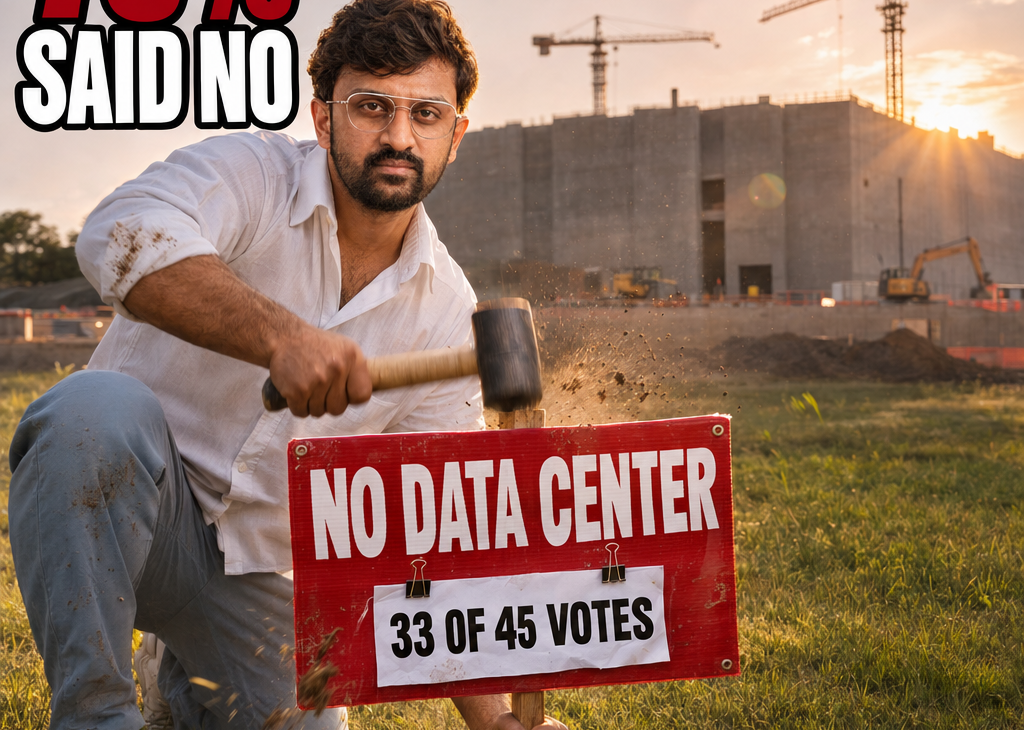
A data center moratorium is no longer a fringe idea. In the US midterm elections on 3 November 2026, 76% of voters polled by NBC News said they opposed data centers in their communities, and 33 of 45 local data center ballot measures are set to restrict development. Here’s what voters decided, why it matters for AI, and what India can learn before its own data center boom.
Key takeaways
- Exit polls: 76% of voters polled by NBC News opposed data centers in their communities, The Verge reports.
- Ballot measures: 45 local measures on data centers; 33 will restrict development, per Redbud Consulting’s tally on 4 November.
- Moratorium supporters won: several winning candidates back a data center moratorium or tighter rules.
- Not one-sided: some winners opposed a full ban but backed making developers pay their own power costs.
- Why it matters: AI depends on new data centers, so local rules could slow the buildout.
Published: 5 November 2026 · Last updated: 5 November 2026 · Status: election results still being finalised
[Insert “Table of Contents by Rank Math” block here]
What happened with data centers in the midterms?
Data centers became one of the clearest local issues of the 2026 US midterms. The Verge reports that voters backed candidates who favour moratoriums and approved ballot measures that put new obstacles in front of data center expansion, “delivering a stinging blow to a central pillar of the AI industry.” The Verge also notes it’s hard to draw a direct line from data center opposition to any single candidate’s win.
The strongest signal came from voters themselves: in NBC News exit polling, 76% said they opposed data centers in their communities. That’s an unusually lopsided result on any issue.
What is a data center moratorium?
A data center moratorium is a temporary ban on approving or building new data centers in an area, usually while officials study their effects on power, water, land and local bills. It doesn’t shut down existing sites. Moratoriums can last months or years, and some apply only to very large facilities above a set power level.
| Tool | What it does | Example from the midterms |
|---|---|---|
| Moratorium | Pauses new approvals for a set time | Wells, Maine: 180-day pause on large data centers |
| Size ban | Bans facilities above a power limit | Several Ohio cities: ban on data centers over 25MW |
| Long-term ban | Blocks large sites for years | El Dorado, Kansas: 10-year ban over 10MW peak load |
| Cost rules | Developers pay for their own grid and water needs | Proposals backed by candidates in several states |
| Transparency rules | Bans secret deals with officials | Pennsylvania order barring non-disclosure agreements |
Which data center ballot measures passed?
Voters faced 45 local data center ballot measures nationwide. As of the morning of 4 November, 33 of them will restrict development, according to a tracker compiled by Redbud Consulting and cited by The Verge. Examples include a 180-day moratorium on large data centers in Wells, Maine; bans on data centers over 25 megawatts in several Ohio cities; and a 10-year ban on sites with peak load over 10 megawatts in El Dorado, Kansas.
What did winning candidates promise?
Positions varied, and the picture isn’t simply one side against the other. Here’s how the key races lined up on data centers, according to The Verge:
| State | Winner’s position on data centers |
|---|---|
| Texas (governor) | Supports a statewide data center moratorium |
| Texas (Senate) | Remove some tax exemptions; make data centers pay their own energy costs; share profits through an “AI dividend” |
| Michigan (Senate) | Pause new developments until they can be done safely |
| Ohio (Senate) | No tax breaks and no approvals without local input |
| Georgia (governor) | Moratorium to review environmental and cost effects |
| South Carolina (Senate) | Two-year moratorium |
| Florida (governor) | Opposed an outright ban; backs making developers pay for their own energy and water |
| Iowa (governor) | Opposed a moratorium; supports ending tax breaks |
| Arizona (governor) | Opposed a moratorium; supports power and water standards |
| Pennsylvania (governor) | Barred non-disclosure agreements and slowed fast-track approvals |
The common thread across winners from both parties is clear: data centers should pay their own way, and local communities should have more say.
Why is there an AI data center backlash?
The AI data center backlash grew because the costs are local and visible while the benefits feel distant. Large AI campuses can need as much electricity as a city, raising fears of higher power bills and blackouts. Cooling can use a lot of water. And many projects were approved quietly, sometimes under non-disclosure agreements with local officials.
- Power bills: residents worry they’ll pay for grid upgrades through higher tariffs.
- Reliability: concern about outages during heatwaves and storms.
- Water: cooling demand in areas already short of water.
- Few jobs: big construction crews, but relatively few permanent jobs.
- Secrecy: deals signed before the public knew.
We covered how companies are responding in our post on OpenAI compute campuses: OpenAI has started calling its sites “compute campuses” and promising to “pay the costs we create.”
What does this mean for the AI industry?
AI models need enormous computing power, and that power comes from data centers. If more towns and states pause or restrict construction, companies may face delays, higher costs and pressure to build elsewhere, including abroad. The Verge reports that a leaked Republican campaign memo warned that if data centers were blamed for losses, politicians “will not go near the next one.”
| Possible effect | Why |
|---|---|
| Slower US buildout | Moratoriums and size limits in some areas |
| Higher costs | Developers paying for grid upgrades and water |
| More transparency | Bans on non-disclosure agreements |
| Shift to friendlier regions | Companies look for places with fewer restrictions |
| More on-site power | Firms build their own generation to avoid grid fights |
Common misunderstandings about the result
- “Data centers are now banned in the US.” No. Restrictions are local or proposed; most of the country has no ban.
- “Only one party opposes data centers.” Candidates from both parties called for cost rules, tax-break limits or local control.
- “This stops AI.” It may slow and reshape where data centers are built, not stop AI development.
- “Every winner promised a moratorium.” Several winners opposed a full ban.
What it means for India
India is courting AI data center investment at speed, with major projects planned in Andhra Pradesh, Telangana, Maharashtra and Tamil Nadu. The US vote is a warning worth heeding early. Indian cities already face summer power peaks and water shortages, and residents near large sites will ask the same questions American voters did.
- Publish the numbers: power and water use for every large project.
- Make developers pay: grid upgrades shouldn’t land on household bills.
- Plan for water: favour sites and cooling designs that don’t strain local supply.
- Share benefits: local jobs, training and community investment.
- Avoid secrecy: transparent approvals build trust and prevent backlash.
Your questions about the data center vote, answered
“Will this make ChatGPT or Gemini more expensive?”
Not directly or immediately. If building data centers becomes slower and costlier, those costs could eventually show up in AI prices, but many other factors matter too.
“Are data centers bad for the environment?”
They use a lot of electricity and sometimes water. The impact depends on the power source, cooling design and location, which is why voters asked for rules rather than simple yes-or-no answers.
“Could India see a similar backlash?”
Yes, if projects strain local power and water without clear benefits. Early transparency and fair cost-sharing are the best ways to prevent it.
7 quick facts about data centers in the midterms
- The US midterm elections were held on 3 November 2026.
- 76% of voters polled by NBC News opposed data centers in their communities.
- There were 45 local data center ballot measures.
- 33 of them will restrict development, per Redbud Consulting.
- Several Ohio cities banned data centers over 25MW.
- Texas, a state with many planned data centers, elected a governor who backs a moratorium.
- Several winners opposed a ban but backed making developers pay their own costs.
How does a data center moratorium work in practice?
A data center moratorium usually follows a simple path. Local or state officials pass a pause, use the time to study effects, then write permanent rules. Projects already approved often continue, while new applications wait.
- Pause: a council, legislature or voters approve a data center moratorium for a set period, such as 180 days or two years.
- Study: officials review power, water, noise, land and tax effects.
- Consult: residents, utilities and companies give input.
- Rules: permanent zoning, size limits, cost-sharing or transparency rules replace the pause.
- Restart: approvals resume under the new rules, or the pause is extended.
That’s why a data center moratorium isn’t the same as a permanent ban. In many places it’s a way to slow down and set rules before the next wave of projects.
Arguments for and against a data center moratorium
The case for a pause
- Gives communities time to study power, water and cost effects before approving more sites.
- Protects households from paying for grid upgrades they didn’t ask for.
- Forces companies to share real numbers and negotiate fairly.
The case against a pause
- Could push investment, jobs and tax revenue to other regions or countries.
- May slow the AI services people and businesses rely on.
- Rules about costs and transparency could address concerns without stopping construction.
Most winning candidates landed somewhere in between: not an open door, not a total ban, but stronger rules and local say.
How much power do AI data centers use?
The International Energy Agency estimated in its 2025 Energy and AI report that data centers worldwide used about 415 terawatt-hours of electricity in 2024, around 1.5% of global demand, and that this could reach about 945 terawatt-hours by 2030, largely because of AI. That growth is the main reason local fights over power have become election issues.
| Measure | Figure |
|---|---|
| Global data center electricity, 2024 | About 415 TWh (about 1.5% of global use) |
| Projected for 2030 | About 945 TWh |
| Main driver | AI workloads |
What can companies do to avoid an AI data center backlash?
The midterm results suggest a clear playbook for any company that wants to keep building, in the US or in India:
- Pay for your own grid upgrades in full, in writing.
- Publish yearly power and water figures for each site.
- Cut demand during grid emergencies and prove it with data.
- Drop non-disclosure agreements with local officials.
- Invest locally in training, jobs and community projects agreed with residents.
These steps cost money, but the data centers midterms results show the alternative can cost more: delays, bans and lost political support.
What happens next?
- New governors and senators take office and may push moratorium or cost-sharing laws.
- Local pauses start in towns that passed data center ballot measures.
- Legal challenges to some restrictions are likely.
- Companies may shift projects to friendlier states or abroad.
- Congress: The Verge expects tougher scrutiny of tech in the next session.
Who is affected by a data center moratorium?
| Group | Effect | What to watch |
|---|---|---|
| Local residents | More say over new projects, possible protection from higher bills | Town and state hearings |
| AI companies | Delays, higher costs, pressure to build elsewhere | Where new campuses are announced |
| Utilities | More time to plan grid upgrades | Rules on who pays |
| Construction workers | Fewer projects in some areas | Shifts to other states |
| AI users worldwide | Possible slower capacity growth, small price effects | AI pricing changes over 2027 |
A quick guide for Indian residents near planned data centers
If a large data center is planned near your town in India, these questions will help you understand what it means for you:
- How much electricity will it use at full load, and who pays for new lines and substations?
- Where will its water come from, and how much will it use in summer?
- How many permanent local jobs will it create, not just construction jobs?
- What happens to power supply for homes during peak demand?
- Has the company published an environmental impact report?
Ask them at public hearings, of your local representatives, or in letters to the state industries department. The US experience shows that early, informed questions shape better projects than late protests do.
Why the data centers midterms result matters beyond the US
American tech companies build AI capacity all over the world. If a data center moratorium spreads across US states, some of that building could move to other countries, including India, the Gulf and Southeast Asia. That brings investment, but also the same questions about power, water and fairness. Countries that set clear, fair rules early are more likely to attract projects that local people accept. The AI data center backlash in the US is, in that sense, a free lesson for everyone else.
Askhari will update this post on the same URL as final results come in and new moratoriums take effect.
Related reading on Askhari
- OpenAI compute campuses
- the AI stock selloff
- Geoffrey Hinton’s AI warning
- Anthropic’s IPO filing warning
Watch: data centers and the midterms, explained
[Paste your YouTube or Instagram video link on an empty line below.]
What we don’t know yet
- Final results of every race and ballot measure.
- Whether new moratoriums will survive legal challenges.
- How AI companies will change where they build.
- Whether federal rules on data centers will follow.
FAQ
What is a data center moratorium?
A temporary ban on approving or building new data centers in an area, usually while officials study power, water and cost effects.
Did data centers affect the 2026 midterms?
Yes. 76% of voters polled by NBC News opposed local data centers, and 33 of 45 local ballot measures will restrict development, The Verge reports.
Are data centers banned in the US now?
No. Restrictions are local and vary by town and state. Most areas have no ban.
Why do people oppose AI data centers?
Concerns include higher power bills, water use, grid strain, noise, few permanent jobs and secret approval deals.
Hari’s take
The midterms showed that AI’s biggest bottleneck may not be chips or talent but public permission. A data center moratorium in one town is local news; dozens of them is an industry problem. Companies that publish real numbers and pay their own way will keep building. Those that hide behind new names and secret deals will face more votes like these.
Follow Askhari for plain-English updates on how AI’s growth is changing power, prices and jobs, including what it means for India’s own data center plans.
Sources: The Verge: Data centers lost the midterms, The Verge: The fight for tech accountability, The Verge AI coverage. Last updated 5 November 2026.