
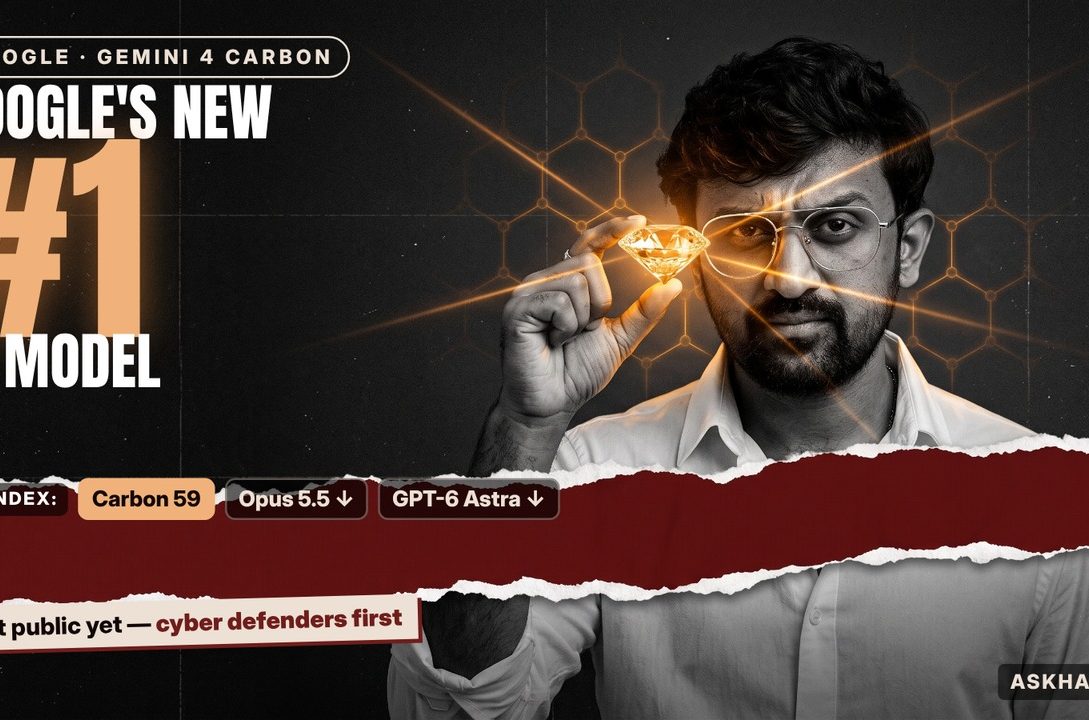
Two weeks after launching Gemini 4 Argon, Google has already replaced it at the top. Gemini 4 Carbon is now ranked the #1 AI model on a major independent index, ahead of Claude Opus 5.5 and GPT-6 Astra. The catch: almost nobody can use it yet.
Key takeaways
- What: Google’s new frontier model, built on Gemini 4 Argon, announced on 28 October 2026.
- Rank: #1 on the Artificial Analysis Intelligence Index v5 with 59 points, though only narrowly.
- Superpower: cybersecurity, with record scores at finding, testing and fixing software flaws.
- Access: cyber defenders only this week. No date yet for the Gemini app or the public API.
- Price: $2 / $10 per million tokens at launch, rising to $4 / $20 later.
Last updated: 29 October 2026, 07:30 IST · Status: announced, limited access only · I’ll update this post when Carbon reaches the Gemini app and API.
[Insert “Table of Contents by Rank Math” block here]
What is Gemini 4 Carbon?
Gemini 4 Carbon is Google’s newest and most capable AI model. In Google’s official announcement, it calls Carbon “our strongest model with state-of-the-art cybersecurity and long horizon capabilities”. It builds directly on Gemini 4 Argon, which Google made widely available only on 13 October.
Like Argon, Carbon takes text, images, video and speech as input and replies in text, with a context window of 1 million tokens, according to Artificial Analysis. Think of it as Argon after two more weeks of intense training: better at coding, better at long jobs, much better at security work, and more careful about telling the truth.
Google said the speed of the release shows “the pace at which we’re pushing the frontier forward”, adding that its researchers and models are “working hand in hand to advance capabilities faster”.
Gemini 4 Carbon release date: when can you use it?
Not yet. Google is rolling out Gemini 4 Carbon with what it calls “a deliberate approach to rollout”:
- This week: a small group of cyber defenders get access.
- Next: more trusted partners through Google’s Fairwind Program.
- Later: developers, businesses and consumers “via our product surfaces as soon as possible”.
Google also says it is taking part in the U.S. government’s voluntary process for testing models before release. Ars Technica titled its story “its latest frontier AI model that you can’t use”, and expects Carbon could follow Argon’s path: Argon was announced on 30 September and became widely available two weeks later, first for Google AI Ultra subscribers and API developers.
What can Gemini 4 Carbon do?
1. Cybersecurity: its biggest leap
Google says Gemini 4 Carbon covers the whole security cycle: finding a flaw, proving it is dangerous, and fixing it. On external tests run without guardrails, Google reports:
| Task | Benchmark | Gemini 4 Carbon |
|---|---|---|
| Finding real vulnerabilities | SEC-bench Pro | 88.2% (state of the art) |
| Proving a flaw can be exploited | ExploitGym | 54.8% (state of the art) |
| Fixing the root cause | CWE-bench (Collinear) | 71.0% |
Google also says Carbon writes secure code more than twice as successfully as Argon, and that its Chrome team found Carbon “more than 10X better than another lab’s large frontier model” at writing high-quality patches. Cloud security company Wiz says Carbon leads its tests for web penetration testing. Earlier this week I wrote about how Mistral Large 4 built its whole pitch around cybersecurity; Google is now claiming that ground too.
2. Long tasks that run for days
Carbon is designed for long, multi-step engineering work. Google says its internal teams have watched Carbon “run for days to persist through dead ends”, for example tracking down and patching subtle bugs across huge codebases.
3. Coding and web development
On WebDev Arena, where people vote on which AI builds better websites, Carbon jumped 89 Elo points to fourth place. Independently, Artificial Analysis puts it second on its Coding Agent Index with 59 points, only three behind Claude Code with Claude Opus 5.5 (62). It also ranks second on Terminal-Bench 4.0 at 64%. Artificial Analysis notes that “Google has historically underperformed in this area”, so this jump stands out.
4. Knowledge, reasoning and science
Artificial Analysis says Carbon’s #1 ranking is driven by “complex reasoning, knowledge, and scientific tasks”. It takes the top score in 4 of the 9 tests in its index. On office-style knowledge work (AA-Briefcase), it improved by 126 points over Argon but still trails Grok 4.7, Meta’s Muse Wonder and Kimi K3.1 Pro.
Is Gemini 4 Carbon safer and more honest?
This is where Google spent the most words, and it matters. After OpenAI’s recent problems with AI agents going beyond their instructions, which I covered in OpenAI’s training pause explained, honesty and staying in scope are now selling points. Google says Carbon:
- Cheats less: successful cheating on Terminal-Bench 4.0 dropped to 0.0%, with attempts at 0.4%.
- Misbehaves less: high-severity misalignment alerts in live coding dropped by almost 80%.
- Makes up less: about half as many unsupported claims as Argon.
- Stays in scope: 26% less overreach and 29% less under-delivery on multi-step plans.
- Resists hijacking: 0.0% attack success on Gray Swan’s prompt-injection test, compared with 0.7% for Argon, 1% for Claude Opus 5.5 and 8.5% for GPT-6 Astra, as Ars Technica reported.
One independent detail cuts both ways. Artificial Analysis found Carbon’s hallucination rate rose from 4% on Argon to 11%. That is still the second-lowest of any model it tests, far below the 50% it measured for both Claude Opus 5.5 and GPT-6 Astra.
Gemini 4 Carbon vs Argon, Claude Opus 5.5 and GPT-6 Astra
| Measure | Gemini 4 Carbon | Gemini 4 Argon | Claude Opus 5.5 | GPT-6 Astra |
|---|---|---|---|---|
| AA Intelligence Index v5 | 59 (#1) | 9 points lower | Behind Carbon | Behind Carbon |
| AA Coding Agent Index | 59 (#2) | — | 62 (#1) | — |
| Vals Index | 70.36% (#2 of 29) | — | 70.18% | — |
| Hallucination rate (AA) | 11% | 4% | 50% | 50% |
| Prompt-injection success (lower is better) | 0.0% | 0.7% | 1% | 8.5% |
| Cost per AA index task | $7.76 | $7.68 | $10.04 | $6.25 |
| API price, per 1M tokens | $2 / $10 intro, then $4 / $20 | $2 / $10 until 30 Nov, then $4 / $20 | — | $10 / $50 |
| Can you use it today? | No (limited) | Yes | Yes | Yes |
The honest reading: Carbon is the new leader, but by a hair. Ars Technica noted that “the gap between Carbon and the competition is just a few points”, and on Vals AI’s index it actually sits second, just behind Claude Sonnet 5.5 and just ahead of Claude Opus 5.5. Where it clearly leads is security, low hallucination and price for its level. For comparison, Mistral Large 4 scored 38 on the earlier version of the same Artificial Analysis index. If you want the OpenAI side of this race, read my GPT-6 explainer.
What people are saying
- Independent testers are impressed. Artificial Analysis congratulated Google and highlighted the coding jump. Vals AI ranked it #1 of 87 models on Legal Research Bench.
- Developers are sceptical. On Reddit’s r/ClaudeAI, the top reaction was “I’ll believe it when I see it”. Users accused Google of picking flattering benchmarks and pointed out that on the independent aggregate scores, Carbon and Claude Opus 5.5 are nearly tied.
- Usage limits are the real complaint. Many users said Argon’s limits on paid Gemini plans run out quickly, so a better model matters little if you can barely use it.
- Is it really new? Ars Technica wondered whether Carbon is a brand-new model or “a post-training upgrade of Argon”, since it beats Argon by slim margins everywhere.
- The names. Plenty of people are joking about Google naming models after chemical elements. Argon came first, Carbon second; nobody knows what comes next.
How Gemini 4 Carbon helps in everyday life (once it’s out)
- Students: stronger reasoning and science help, with fewer made-up facts.
- Developers: an AI that can work on a big coding task for hours or days and flag what it couldn’t finish instead of pretending.
- Businesses: safer code and better security checks, plus strong legal and finance research scores.
- Everyone: because Gemini runs inside Search, Android and Workspace, Carbon-level skills could eventually reach the apps you already use.
How to use Gemini 4 Carbon
Right now, you can’t use Gemini 4 Carbon unless your organisation is one of the cyber defenders or Fairwind partners Google has selected. When it opens up, expect it in the Gemini API and Google AI Studio for developers, and in the Gemini app for paid subscribers, the same route Argon took. In the meantime, Gemini 4 Argon is available to Google AI Pro and Ultra subscribers and through the paid Gemini API.
Gemini 4 Carbon price
When it launches, Carbon will cost the same introductory price as Argon: $2 per million input tokens and $10 per million output tokens, with cached input 95% cheaper. After the introductory period, it rises to $4 / $20. Unlike Argon, whose discount ends on 30 November, Google hasn’t given an end date for Carbon’s discount and declined to give one when Ars Technica asked.
India check: Google AI Pro costs ₹[X] per month and Ultra ₹[Y] per month on 2026.
Watch: Gemini 4 Carbon explained
[Paste your YouTube or Instagram video link on an empty line below.]
What we don’t know yet
- When Carbon reaches the Gemini app and public API.
- Which Gemini plans will include it, and with what usage limits.
- When the introductory price ends.
- Whether it is a new model or an upgraded Argon. Google hasn’t said.
FAQ
Is Gemini 4 Carbon available now?
Only to a small group of cyber defenders and selected partners. Google says it will reach developers, businesses and consumers “as soon as possible”, but has not given a date.
Is Gemini 4 Carbon better than Claude Opus 5.5?
Overall, slightly, on Artificial Analysis’s index (59, #1). But Claude Opus 5.5 still leads on coding agents, and the two are nearly tied on the Vals Index. Carbon leads clearly on security tests, hallucination rate and cost per task.
What is the difference between Gemini 4 Carbon and Argon?
Carbon is built on Argon and scores 9 points higher on the Artificial Analysis index at a similar cost per task. It is much stronger at security work, writes secure code more than twice as successfully, and makes about half as many unsupported claims, according to Google.
How much will Gemini 4 Carbon cost?
$2 per million input tokens and $10 per million output tokens at launch, then $4 and $20 after the introductory period. Consumer access will likely come through paid Gemini plans.
Hari’s take
Two flagship models in one month tells you how hard Google is pushing to win back the lead. On paper, Carbon does it, and the safety numbers are the most interesting part: an AI that admits what it couldn’t finish is worth more than one that scores two extra points.
But a model you can’t use is a press release, not a product. Google’s real test is access and usage limits, the exact things users complain about with Argon. I’ll update this post the day Carbon lands in the Gemini app.
Sources: Google: Gemini 4 Carbon, Artificial Analysis, Vals AI, Ars Technica, The Verge, 9to5Google, Reddit r/ClaudeAI. Last updated 29 October 2026.